Can we get better at "Seeking Reasons"?
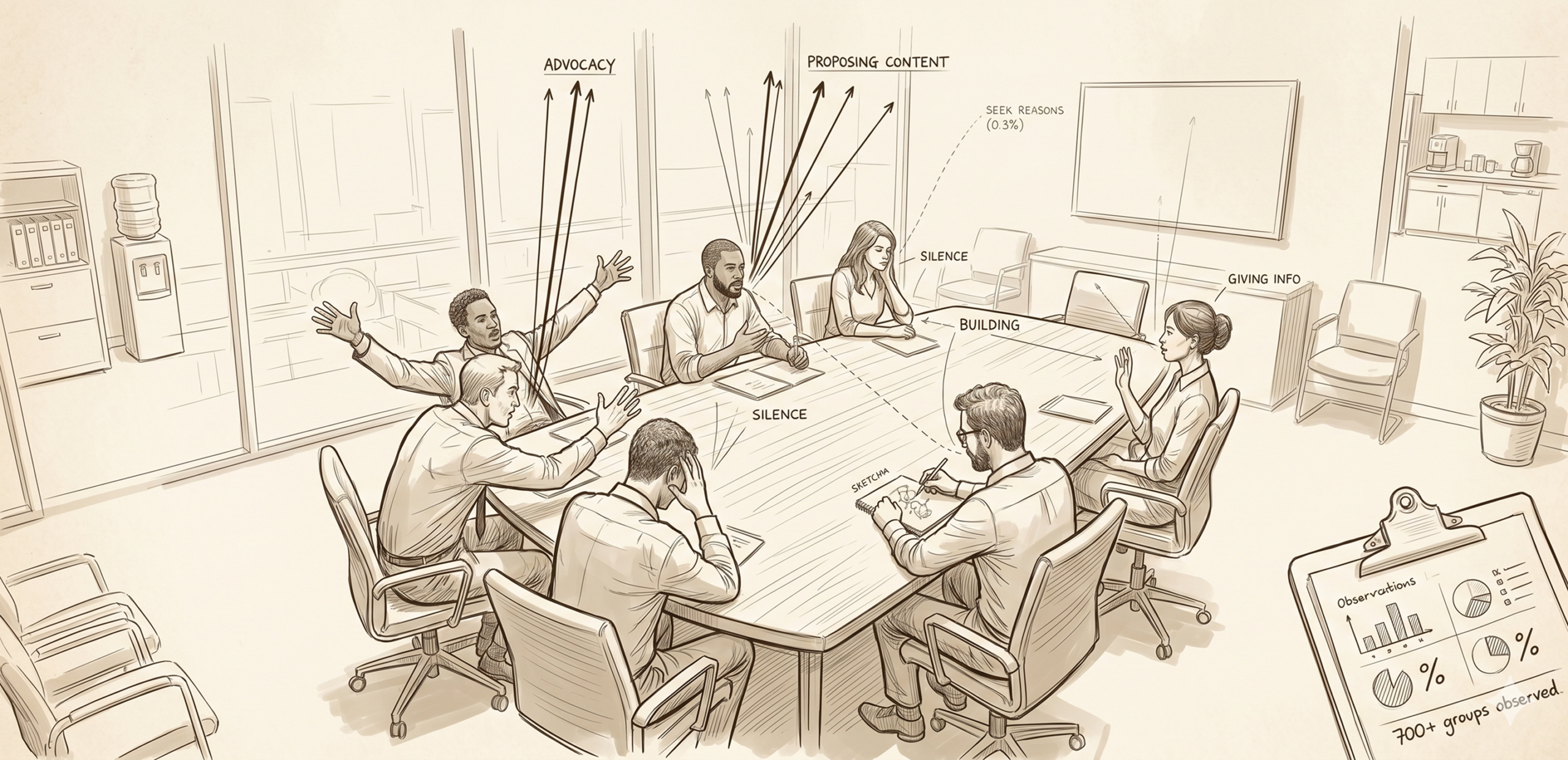
In Part 1 of this series, we established a striking reality: seeking reasons—the verbal behavior most associated with causal understanding and sound decision-making—is the second-least used behavior in over 700 problem-solving and decision-making meetings observed by AirtimeBA practitioners.
In Part 2, we explored why. The deck is stacked against it: status dynamics, trust deficits, organizational culture acting like an immune system, the tyranny of time pressure. It was a frank accounting, and it ended with the glass half empty by design.
This is the glass-filling post.
But a word of caution before we proceed. If the barriers described in Part 2 are real, the response cannot be a cheerful list of quick fixes. What is needed is an intentional, structured approach that matches the sheer size of the opportunity.
“The very fact that we can observe, measure, and name this behavior means we can cultivate it. What gets measured gets managed—and what gets managed can become a powerful advantage. AirtimeBA has been measuring this for years.”
Start Here: Curiosity as a Muscle, Not a Trait
There is a common misconception worth dismantling upfront. Many people assume that the tendency to ask ‘why’ is a personality trait—something you either have or you don’t.
The research does not support this. Curiosity, and with it the behavior of seeking reasons, is more accurately understood as a disposition that can be developed. It isn’t just a personal quirk; it’s a practice that drives a team forward. We aren’t simply waiting for curious people to show up. We can actively create the conditions in which seeking reasons becomes a natural reflex for anyone.
Studies on workplace behavior show that when curiosity is triggered, people think more deeply about decisions and generate more creative solutions. Yet, despite claiming to value curious minds, many organizations inadvertently suppress inquiry, fearing it will slow things down. Only about 24% of employees report feeling curious in their jobs on a regular basis, and nearly 70% face active barriers to asking questions.
This is not just a gap. It is a massive, untapped structural opportunity.
The good news is that behavior change is highly achievable when the right conditions are in place. The most consistently effective strategy is simply reconnecting to why the behavior matters before entering a meeting or conversation. For seeking reasons, the upside is already well established by Parts 1 and 2 of this series.
Three Levels of Practice
Capitalizing on this opportunity requires action at three distinct levels. None of them alone is sufficient, but together, they reshape how a team thinks.
Level 1: The Individual — Building the Habit
At the individual level, the goal is to make seeking reasons feel less like a forced effort and more like second nature. This requires deliberate practice. Some concrete starting points:
- Set a behavioral intention: Before a meeting where a decision will be made, tell yourself: ‘I will ask at least one why-oriented question before we converge on a course of action.’
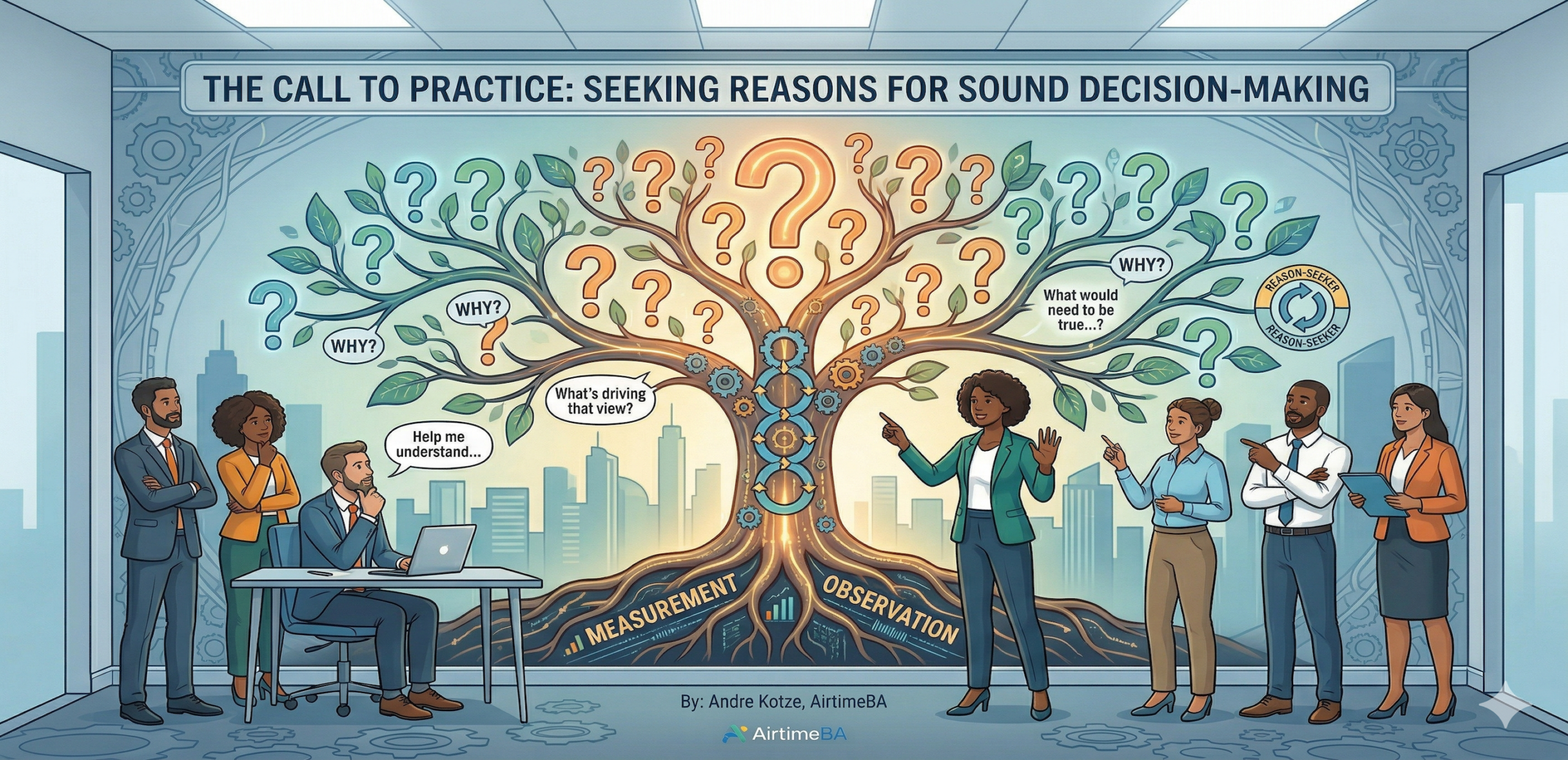
- Vary the form: The word ‘why’ can sometimes feel like a challenge. Alternative framings—‘What’s driving that view?’, ‘Help me understand the thinking behind that’, ‘What would need to be true for that to work?’—open the door to deeper insights while building interpersonal trust.
- Self-monitor: Did you seek reasons today? When did you hold back? What stopped you? Reflective practice grounded in observable behavior is how the habit builds momentum over time.
- Use it as a micro-practice: Spend five minutes questioning one assumption in your current work. Ask ‘Why do we do it this way?’ not as a challenge, but as genuine inquiry.
Treat seeking reasons the way athletes treat technique: it requires conscious rehearsal before it fires automatically and elevates your game.
Level 2: The Leader — Modeling Is the Lever
If the individual practitioner is where habit begins, the leader is where culture is shaped. Leader behavior is the primary driver of whether seeking reasons becomes an organizational superpower or remains the exception.
Leaders who visibly model the behavior—who pause to ask ‘what’s the reason behind that view?’ before advocating their own—send a powerful signal. They show their teams that deep understanding is valued over fast, fragile consensus.
To create an environment that unlocks this kind of questioning, leaders should:
- Frame the work: Ensure everyone understands what is at stake and how the quality of their collective reasoning elevates the final outcome.
- Invite engagement: Ask open questions genuinely, not rhetorically. The group feels the distinction immediately and steps into the space provided.
- Respond productively: Don’t just thank people for their input; actively incorporate the reasoning that surfaces into the path forward.
This grows psychological safety—a shared belief that the team is safe for interpersonal risk-taking. For leaders, the question is not simply ‘what should I ask?’ but rather ‘how can I create a space where our best collective thinking can emerge?’
Level 3: The Organization — Redesigning the Defaults
Part 2 described organizational culture as an immune system, fiercely resistant to foreign elements. Rather than fighting that system head-on, organizations have the opportunity to redesign the defaults.
Applied to seeking reasons, this means asking: what would it look like if our meeting structures, agendas, and post-meeting routines naturally paved the way for inquiry?
- Build a ‘reason-seeking moment’ into agendas: Create a structured, expected pause before any decision is finalized, inviting the group to surface the ‘why’ behind the leading proposals.
- Rotate the role of ‘reason-seeker’: Make it a named, expected function in team meetings. This distributes the behavior and empowers everyone to contribute to better outcomes.
- Introduce explicit behavioral norms: Say it out loud during onboarding or team resets: “On this team, we ask why before we decide. It isn’t a challenge to anyone’s expertise; it’s how we harness our collective intelligence.”
- Debrief decisions: Post-decision reviews that look at what reasoning was and wasn’t explored create a continuous learning loop that sharpens future performance.
A Lesson from Toyota — Building on a Strong Foundation
The most famous organizational attempt to institutionalize reason-seeking is Toyota’s “Five Whys” methodology. The principle is simple: when a problem arises, ask ‘why’ five times in succession to cut through the symptoms and reach an actionable root cause.
The technique is brilliantly effective, but its success reveals an important truth: the Five Whys functions best in an environment where people already feel safe identifying systemic problems, and where leadership is genuinely committed to improvement.
The question isn’t whether your team has a clever technique for asking why. Most do. The real opportunity lies in making seeking reasons a natural, frequent behavior in the actual verbal fabric of your meetings. When the cultural conditions support it, a simple technique becomes a powerful engine for continuous improvement.
The Call to Practice
The data AirtimeBA has gathered over 700+ groups tells a consistent story: teams are sitting on a vast, untapped reservoir of collective intelligence. The upside to tapping into it—decisions built on thoroughly tested assumptions, proposals advancing with examined logic, and teams moving with true alignment—is immense.
Because this behavior can be observed, measured, and coded, it can be grown. Unlike culture change, which is long and unpredictable, behavioral change at the individual and team level can begin in your very next meeting.
Moving from Observation to Action:
- Start Today: Set a behavioral intention before your next meeting. Ask one ‘why-oriented’ question before a decision is made. Notice the quality of the conversation that follows.
- Build Toward: Build reason-seeking into meeting agendas structurally. Rotate the ‘reason-seeker’ role. Lead debrief sessions that surface hidden insights. Measure the behavior.
Organizations and leaders who embrace this opportunity will make better decisions. Not because they have more information or more time, but because they have challenged more assumptions, surfaced hidden insights, and built a profound collective understanding.
The rarity of reason-seeking is not a permanent condition. It is a powerful advantage waiting to be built.
Andre Kotze is CEO of AirtimeBA, a B2B consultancy specializing in behavioral analysis and communication optimization. AirtimeBA has curated a set of averages from hundreds of thousands of verbal behaviors across 700+ problem-solving and decision-making meetings.